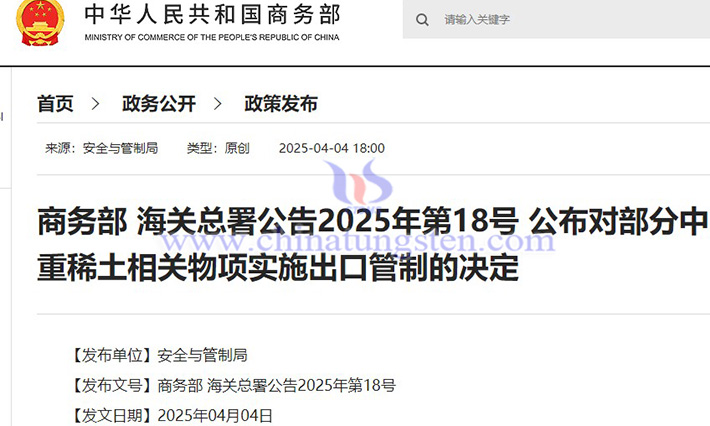
On April 4, 2025, China’s Ministry of Commerce, in collaboration with the General Administration of Customs, announced export control measures on seven categories of medium and heavy rare earth-related items—samarium (Sm), gadolinium (Gd), terbium (Tb), dysprosium (Dy), lutetium (Lu), scandium (Sc), and yttrium (Y)—effective immediately upon release. This policy is poised to have multifaceted impacts on the rare earth industry, influencing supply-demand dynamics, market prices, and the global industry landscape.
I. Impact on Market Supply and Demand
Overseas Supply Shortages
China dominates the global supply of medium and heavy rare earths, a position that other countries cannot easily replicate in the short term. The export controls are likely to create supply shortages in overseas markets for these critical elements. However, since the policy involves export controls rather than a complete ban—allowing exports upon approval—the actual impact may be less severe than theoretical estimates suggest. According to the U.S. Geological Survey (USGS), in 2024, China held the world’s largest rare earth reserves at 44 million tons, accounting for 48.89% of the global total, and produced 270,000 tons (assuming "27 tons" in the original text is a typo), representing 69.23% of global output.
Domestic Market Dynamics
In the short term, domestic spot inventories of some medium and heavy rare earth products may increase, prompting companies to reduce production to align with market adjustments. Notably, imports of rare earth ores from Myanmar remain constrained. Over the long term, however, growing domestic demand for these elements, coupled with stringent national oversight and resource allocation, will likely stabilize and streamline China’s domestic supply.
II. Impact on Market Prices
Overseas Price Increases
The export controls may tighten global supplies of medium and heavy rare earths, driving up prices in overseas markets due to heightened scarcity.
Enhanced Domestic Price Support
Rising overseas prices could spill over into China, bolstering domestic prices for medium and heavy rare earths. However, medium-term price trends in China will also depend on 2025 domestic quotas and demand conditions.
For reference, January–March 2025 data shows: Praseodymium Oxide: 447,579 CNY/ton, up 12.40% year-on-year. Neodymium Oxide: 440,719 CNY/ton, up 11.73% year-on-year. Praseodymium-Neodymium Oxide: 430,158 CNY/ton, up 11.97% year-on-year. Praseodymium-Neodymium Metal: 529,491 CNY/ton, up 11.28% year-on-year. Terbium Oxide: 6,211 CNY/kg, up 8.21% year-on-year. Dysprosium Oxide: 1,692,281 CNY/ton, down ~13.11% year-on-year. Dysprosium-Iron Alloy: 1,655,421 CNY/ton, down ~13.45% year-on-year.
III. Impact on the Rare Earth Industry Landscape
Strengthened Chinese Dominance
The export controls reinforce China’s commanding position in the global rare earth supply chain. Countries such as the U.S., Japan, and South Korea, heavily reliant on Chinese supplies, face short-term challenges in securing alternatives, enhancing China’s influence over pricing and market dynamics. According to China Tungsten Online, between 2020 and 2023, the U.S. depended significantly on China for rare earth compounds and metals, with China serving as its largest supplier due to abundant reserves, advanced technology, and a comprehensive industrial chain.
Catalyst for Industry Upgrades
The policy encourages domestic firms to optimize resource allocation and increase R&D investment in mining, beneficiation, smelting, and downstream processing. This push aims to improve resource efficiency and product quality, steering the rare earth industry toward high-end, intelligent, and green development.