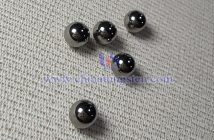
Tungsten bead sintering is a crucial step in preparing high-performance tungsten beads. Its core lies in using high-temperature treatment to bond tungsten powder particles, forming dense and high-performance tungsten beads.
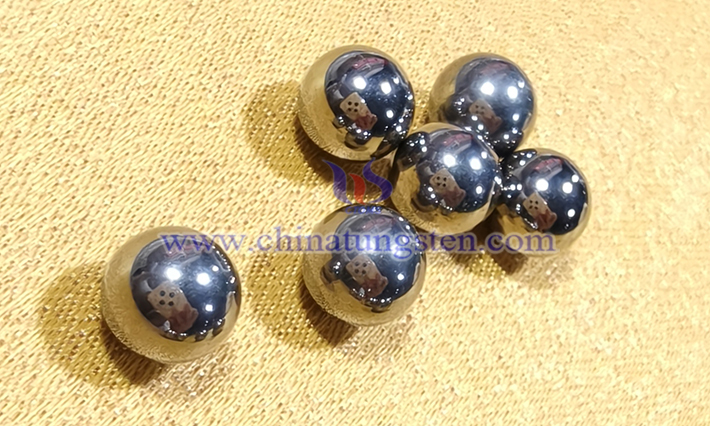
I. Types of Sintering Processes
Solid-phase sintering: Performed at temperatures below the melting points of the low-melting-point components, with no liquid phase formation. This process avoids billet deformation caused by liquid phase flow and tungsten particle settling, but the amount of liquid phase generated at the interface results in lower bond strength.
Liquid-phase sintering: Suitable for two-phase alloy systems composed of a high-melting-point tungsten phase and a low-melting-point γ phase (such as Ni-Cu, Ni-Fe). The liquid phase medium promotes the densification of the metal powder. The sintering process is divided into three stages: liquid phase formation and particle rearrangement, dissolution-precipitation, and solid-phase framework formation. This process can achieve rapid densification, but precise control of the liquid phase amount is required to avoid abnormal grain growth.
Two-step sintering: First, solid-state sintering is performed below the liquidus temperature of the low-melting-point components to form a relatively dense framework; then, heating above the liquidus line results in liquid-phase sintering. This process combines the advantages of both liquid-phase and solid-state sintering, helping to suppress dissolution and tungsten particle agglomeration and growth.
Spark plasma sintering (SPS): Pulsed current is used to rapidly break down the oxides on the powder surface, purifying the particle surface and activating the particles with plasma. Rapid heating and cooling, along with short-term holding times, are achieved by electrically heating to the sintering temperature, suppressing particle growth and obtaining a fine and uniform grain structure.
Hot isostatic pressing (HIP): The powder is placed in a high-pressure container and densified under high temperature and isostatic pressure. This process eliminates internal porosity, obtaining isotropic, high-performance tungsten beads.
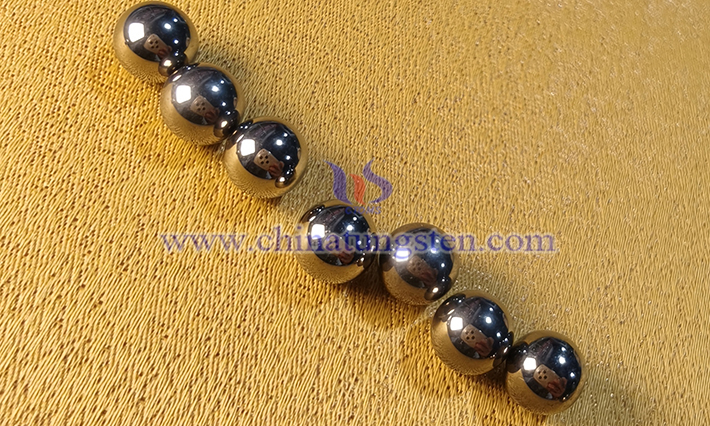
II. Process Parameter Control
Temperature: The sintering temperature needs to be optimized based on the purity, particle size, and type of additives in the tungsten powder. For example, the sintering temperature of pure tungsten is typically between 1800-2200℃, while the sintering temperature of tungsten alloys with binders such as nickel can be appropriately lowered.
Time: The holding time needs to be long enough to ensure sufficient particle bonding, but excessive time may lead to grain coarsening. Holding time usually ranges from 30 minutes to several hours, and needs to be adjusted according to the specific process and equipment.
Pressure: In hot pressing or hot isostatic pressing, pressure is a key factor in promoting densification. Too low a pressure may result in insufficient density, while too high a pressure may cause equipment damage or billet deformation.
Atmosphere: The sintering atmosphere needs to be selected according to the properties of the tungsten powder. A hydrogen atmosphere can prevent oxidation and promote reduction reactions, while a vacuum atmosphere is suitable for the preparation of high-purity tungsten beads.