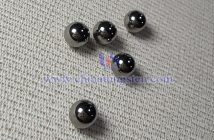
Tungsten beads and zirconia beads are two mainstream high-performance grinding media in the field of ultrafine grinding, commonly used in sand mills, planetary ball mills, and other equipment. Their performance differs significantly in density, hardness, wear resistance, toughness, and contamination control, directly impacting grinding efficiency, product purity, and overall cost.
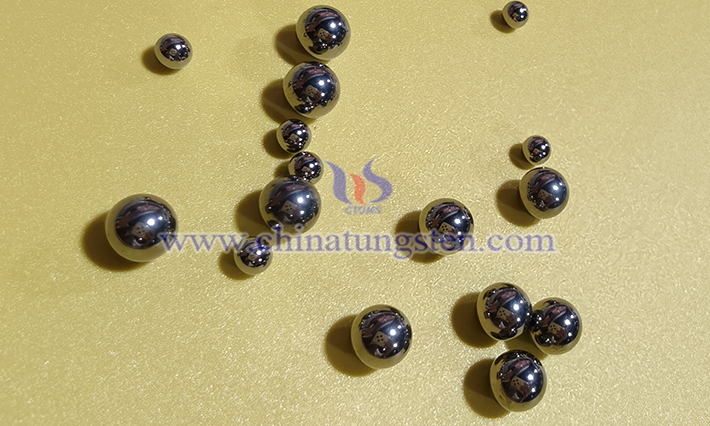
1. Tungsten Beads Possess Greater Density and Impact Energy
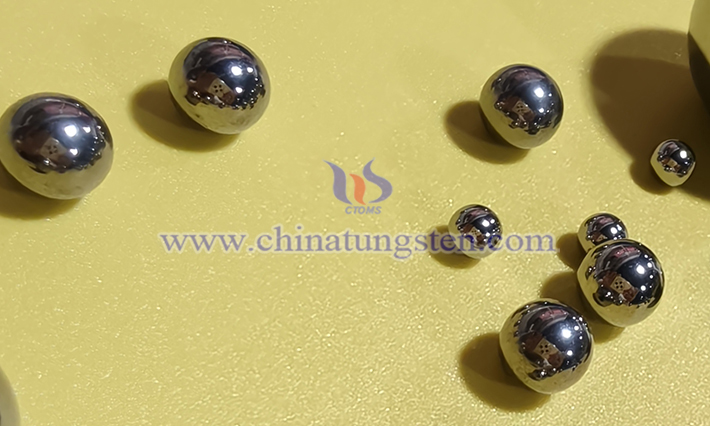
Tungsten beads (tungsten carbide beads, cemented carbide beads) have a density as high as 14.5-15.0 g/cm3, approximately 2.4 times that of zirconia beads (6.0-6.2 g/cm3). This means that for the same volume, tungsten beads have a greater mass and transfer more kinetic energy in a single impact, making them particularly suitable for the rapid pulverization of high-viscosity slurries or extremely hard materials. In nanoscale grinding, tungsten beads often significantly shorten processing time and improve efficiency.
2. Tungsten beads possess higher hardness and wear resistance.
Tungsten carbide typically has a Vickers hardness of 1600-2000 HV, significantly higher than zirconium oxide's 1200-1350 HV, and a Mohs hardness close to 9.5 (approaching diamond). Therefore, tungsten beads exhibit superior wear resistance to ultra-hard materials (such as silicon carbide, boron nitride, and cemented carbide), with extremely low wear, often more than an order of magnitude lower than zirconium oxide. This gives them an advantage in mechanical alloying and high-energy ball milling experiments.
3. Zirconia beads possess stronger toughness and shatter resistance.
Zirconium oxide, through a phase transformation toughening mechanism (stress-induced martensitic transformation), has fracture toughness far exceeding that of tungsten carbide. While tungsten beads are hard, they are relatively brittle and prone to micro-chipping and fragmentation under high linear speed or high impact conditions. Zirconia beads, on the other hand, are less prone to breakage in high-speed sand mills, resulting in a more stable and reliable service life.
4. Zirconia beads offer superior contamination control.
Zirconium oxide beads are extremely chemically inert, with virtually no metal ion leaching, making them ideal for applications with stringent purity requirements, such as lithium-ion battery cathode and anode materials, electronic ceramics, pharmaceuticals, and food. While tungsten carbide beads are available in cobalt-free or low-cobalt versions, trace amounts of tungsten or cobalt may still be introduced, which is detrimental to high-purity products.
Based on the above performance comparison, tungsten beads are the preferred choice when the target is extremely hard materials, rapid nanoscale pulverization, and high contamination tolerance; zirconia beads are chosen when low contamination, long lifespan, and high stability are emphasized. A combined strategy of coarse and medium grinding with tungsten bead final grinding controls costs while achieving the ultimate fineness.