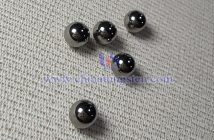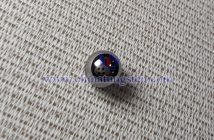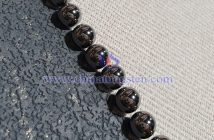
Tungsten beads typically refer to small spherical particles made of pure or high-purity tungsten. Their conductivity primarily depends on the inherent electrical properties of tungsten. Tungsten (W) is a transition metal known for its extremely high melting point (approximately 3410℃), high density (19.25 g/cm3), and excellent high-temperature stability, and also exhibits excellent electrical properties.
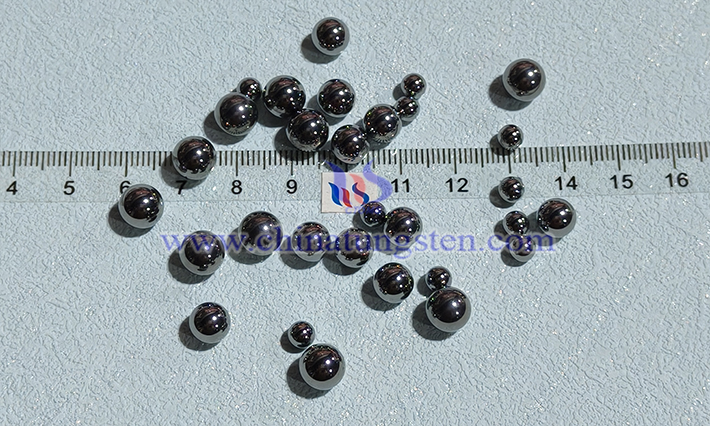
The electrical conductivity of tungsten at room temperature (20℃) is approximately 1.79 × 10? S/m (Siemens per meter), corresponding to a resistivity of approximately 5.28–5.65 × 10?? Ω·m. This value indicates that tungsten's conductivity is above average, significantly higher than common metals like iron (approximately 1.0 × 10? S/m) and nickel, but noticeably lower than silver (6.3 × 10? S/m), copper (approximately 5.96 × 10? S/m), and gold (approximately 4.1 × 10? S/m). Among all pure metals, tungsten's conductivity typically ranks among the top ten, roughly equivalent to about 28% of silver's.
The conductivity of tungsten beads primarily stems from the large number of free electrons in their body-centered cubic crystal structure. These free electrons can move relatively freely and directionally under an electric field, thus enabling current conduction. Compared to face-centered cubic metals like copper and silver, tungsten has a slightly higher electron scattering probability, resulting in a relatively higher resistivity, which is one reason why it maintains good conductivity even at high temperatures.
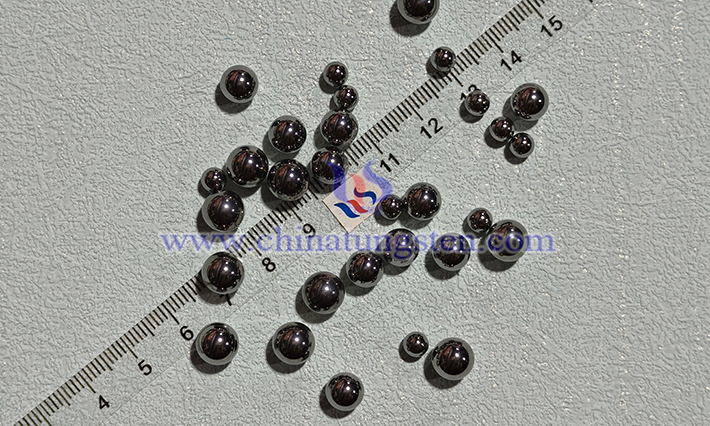
It is worth noting that tungsten's resistivity exhibits a significant temperature dependence. It is a positive temperature coefficient material, meaning its resistivity gradually increases with increasing temperature. This is because lattice vibrations intensify at high temperatures, increasing collisional scattering of electrons with the lattice and hindering directional electron migration.
In practical applications, pure tungsten beads exhibit highly reliable conductivity and are commonly used in scenarios requiring a balance of conductivity, high-temperature resistance, and corrosion resistance. Examples include applications in electrical contact materials (such as high-voltage switch contacts), EDM electrodes, and counterweights and conductive components in certain precision electronic parts.
It is worth noting that tungsten carbide beads or cemented carbide beads have lower conductivity, typically only a fraction of that of pure tungsten (approximately 0.7 × 10? S/m), because tungsten carbide has a structure closer to ceramic, resulting in a significantly reduced number of free electrons.