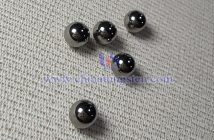
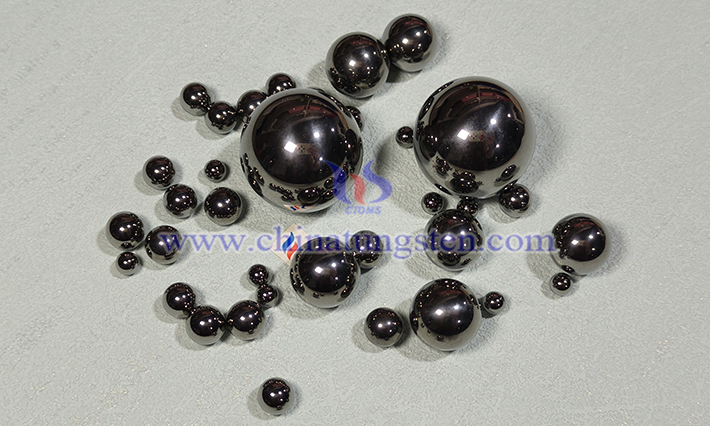
Tungsten beads are a common form of high-purity or high-density tungsten materials (such as high-density tungsten alloy beads). Their volumetric thermal expansion coefficient (usually denoted as β or γ) is an important parameter of the material's thermal properties. It describes the relative rate of change of the material's volume with increasing temperature.
The coefficient of thermal expansion is divided into the linear expansion coefficient (α), the area expansion coefficient (β≈2α), and the volumetric expansion coefficient (γ≈3α). For isotropic materials (such as pure tungsten with a body-centered cubic structure), the volumetric expansion coefficient has a strict approximate relationship with the linear expansion coefficient: γ≈3α. Here, α is the linear thermal expansion coefficient, typically expressed in units of 10??/K (or μm/m·K).
The linear thermal expansion coefficient α of pure tungsten at room temperature (approximately 20–25°C) is about 4.4–4.5 × 10??/K. This value is among the lowest of all pure metals, second only to certain special alloys. This is due to the extremely strong metallic bonds between tungsten atoms and its body-centered cubic crystal structure, which results in small atomic vibration amplitudes and high lattice rigidity.
The volume expansion coefficient of pure tungsten is approximately: γ ≈ 3 × 4.5 × 10??/K = 13.5 × 10??/K. Actual measurements typically fall within the range of 13–13.5 × 10??/K (near room temperature). This value increases slightly at higher temperatures but remains generally low. Tungsten alloy beads have a slightly higher coefficient of volumetric expansion than pure tungsten, typically exhibiting a linear expansion of 4.8–6.0 × 10??/K, corresponding to a volumetric expansion of approximately 14.4–18 × 10??/K, still significantly lower than that of conventional metals.
It is understood that aluminum has a linear thermal expansion coefficient α≈23 × 10??/K and a volumetric expansion coefficient γ≈69 × 10??/K. Copper has a linear thermal expansion coefficient α≈17 × 10??/K and a volumetric expansion coefficient γ≈51 × 10??/K. Steel/iron has a linear thermal expansion coefficient α≈12 × 10??/K and a volumetric expansion coefficient γ≈36 × 10??/K.
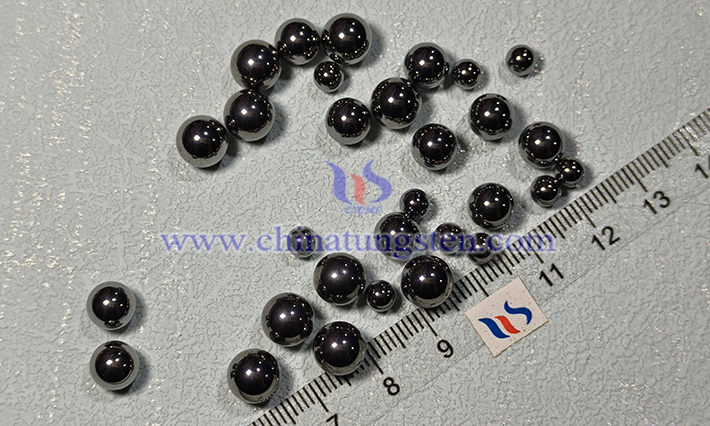
Tungsten's volumetric expansion coefficient is only about 1/3 that of steel and about 1/5 that of aluminum. The low coefficient of volume expansion brings the following advantages: (1) High temperature dimensional stability: In engines, vacuum furnaces or X-ray equipment, the volume change is minimal during temperature cycling, avoiding gap changes or stress concentration. (2) Compatibility with other materials: In composite structures (such as tungsten beads combined with steel/copper/aluminum), the low expansion of tungsten can reduce thermal stress and prevent cracking or falling off. (3) Precision positioning: When used in gyroscopes and inertial devices, the volume change caused by temperature drift is small, which is beneficial to maintaining high precision.