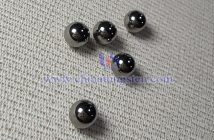
Tungsten beads are chemically stable and almost immune to most common chemical media at room temperature. However, they will react significantly in high-temperature oxidizing atmospheres or certain highly corrosive mixed acids.
1. Tolerance to Inorganic Acids (Room Temperature)
Common Inorganic Acids: Highly resistant to hydrochloric acid (any concentration), sulfuric acid (dilute-concentrated), nitric acid (dilute-concentrated), phosphoric acid, and aqua regia (cold/room temperature) at room temperature.
Hot concentrated nitric acid and hot concentrated sulfuric acid: May cause slight surface oxidation, but not significant dissolution.
Hydrofluoric acid: Slow corrosion when used alone.
Mixed solution of hydrofluoric acid (HF) and concentrated nitric acid (HNO?): Dissolves tungsten relatively quickly at room temperature. The reaction is vigorous, releasing heat and nitrogen oxide gases, and rapidly forming soluble tungsten-fluorine complexes (such as [WF?]2? or related compounds).
2. Tolerance to Alkalis
Dilute alkaline solutions (NaOH, KOH aqueous solutions, room temperature): Virtually no reaction.
Concentrated alkaline solutions (room temperature): Extremely slow reaction or no significant corrosion.
Molten strong alkali + oxidizing agent (e.g., KNO?, Na?O?, KClO?, etc. added to NaOH/KOH melt): Rapid corrosion, forming tungstates.
This is the most vulnerable condition for tungsten in alkaline media, commonly used in industrial tungsten recycling.
3. Reaction with Halogens/Nonmetals
Fluorine (F?): Reacts directly and violently at room temperature, forming volatile tungsten hexafluoride (WF?) (colorless gas, highly toxic).
Chlorine (Cl?): Reacts above approximately 250℃, forming tungsten hexachloride (WCl?) (dark blue solid).
Bromine (Br?): Similar to chlorine, forming WBr? at approximately 250–300℃. Iodine (I?): Reacts slowly under red heat, forming low-valent iodides.
Others: Reacts with carbon at high temperatures to form tungsten carbide (WC, W?C), and with sulfur to form tungsten sulfide (WS?).
4. Reactions with Other Media
Water/Moist Air: Completely stable at room temperature, does not hydrolyze or rust.
Hydrogen (H?): Does not react even at high temperatures; tungsten is one of the few metals that does not absorb hydrogen.
Hydrogen Peroxide (H?O?): Slowly dissolves tungsten, commonly used in analytical chemistry for sample dissolution.
Organic Acids/Organic Solvents: Virtually unreacted.
Molten Salts: Some molten oxidizing salts (such as Na?O?) will rapidly oxidize and dissolve.