
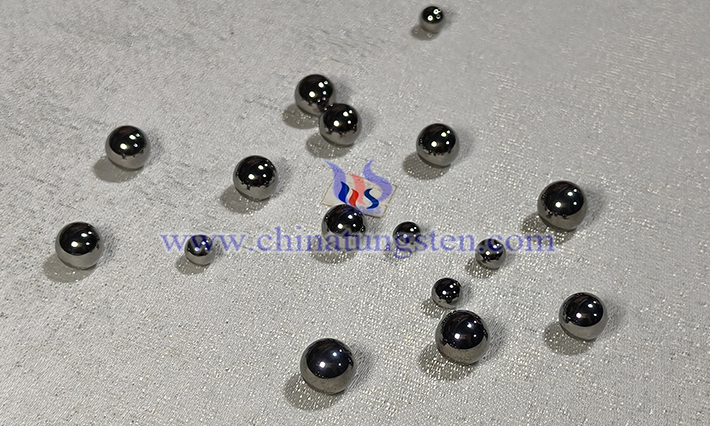
Tungsten beads typically refer to spherical particles or small balls made of high-purity tungsten material, such as tungsten balls or beads used for shooting, counterweights, scientific experiments, or industrial purposes. The melting point of tungsten beads varies depending on the added elements (such as carbon, cobalt, nickel, iron, etc.), and is generally lower than the melting point of pure tungsten. Metallic tungsten has the highest melting point of all metallic elements; the internationally recognized melting point of pure tungsten is 3422°C (approximately 6192°F, or 3695 K).
Tungsten's remarkably high melting point is primarily due to its unique atomic structure: tungsten has atomic number 74, is located in group VIB of period 6, and has an electronic configuration of [Xe] 4f1? 5d? 6s2; it forms strong metallic bonds, especially covalent metallic bonds involving 5d electrons, resulting in extremely strong interatomic bonding; it has a body-centered cubic (BCC) crystal structure with tight packing; and it has a low coefficient of thermal expansion, maintaining structural stability even at high temperatures. These properties mean that breaking the tungsten lattice and transforming it from a solid to a liquid state requires extremely high energy, thus its melting point far exceeds that of other metals.
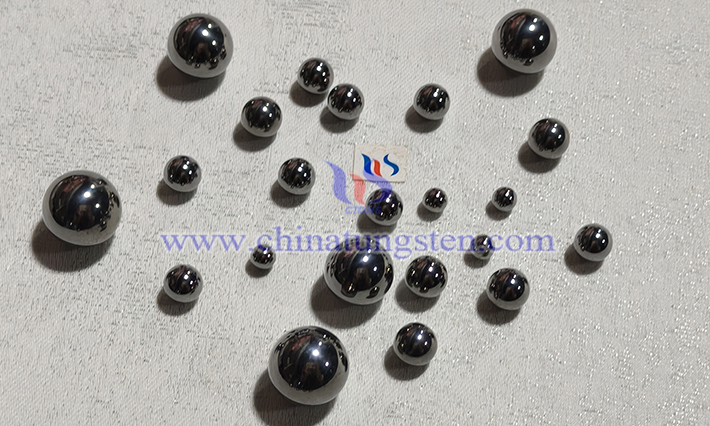
Tungsten's high melting point makes it widely used in extreme high-temperature applications such as incandescent lamp filaments, high-temperature electrodes, and vacuum furnace heating elements. Tungsten beads are commonly used in high-density counterweights, such as fishing sinkers, racing car weights, golf ball weights, and medical device counterweights, where they remain solid and undeformed even under extreme conditions. In the military field, they are important materials for armor-piercing projectile cores and high-density munitions, where their high melting point ensures they do not melt during high-speed impacts and high-temperature friction. In the industrial field, they are used in high-temperature heating elements and X-ray tube anode targets, where they can work stably for long periods at high temperatures.