Major Events in the Rare Earth Industry in 2025
In January, China Northern Rare Earth plans to invest RMB 153 million in self-owned funds to establish a joint venture with its shareholding company Fujian Golden Dragon Rare Earth, forming Northern Golden Dragon (Baotou) Rare Earth Co., Ltd. (new company), and using the new company as the entity to construct a 5,000-ton rare earth oxide separation production line project, promoting high-quality utilization of northern and southern rare earth resources.
In January, due to adjustments in operating strategy, China Northern Rare Earth plans to stop releasing monthly listed prices starting from January 2025, with future long-term agreement prices potentially adopting the daily quotes published by the Rare Earth Exchange.
In January, China Northern Rare Earth released an announcement stating that the rare earth concentrate transaction price for the first quarter of 2025 is adjusted to RMB 18,618/ton excluding tax (dry quantity, REO=50%), increased by approximately 4.7% month-on-month and decreased by approximately 10.22% year-on-year; for each 1% increase or decrease in REO, the price excluding tax increases or decreases by RMB 372.36/ton, increased by approximately 4.7% month-on-month and decreased by approximately 10.22% year-on-year.
In January, Jinzhou Petrochemical achieved a major breakthrough in rare earth butadiene rubber product R&D, successfully completing the evaluation of ultra-narrow distribution medium Mooney and high Mooney rare earth butadiene rubber trial products.
On January 17, according to People's Political Consultative Conference Network, the China Geological Survey of the Ministry of Natural Resources discovered an ultra-large-scale ionic adsorption type rare earth deposit in the Honghe region of Yunnan Province, with potential resources of 1.15 million tonnes. Among them, key rare earth elements such as praseodymium, neodymium, dysprosium, and terbium exceed 470,000 tonnes.
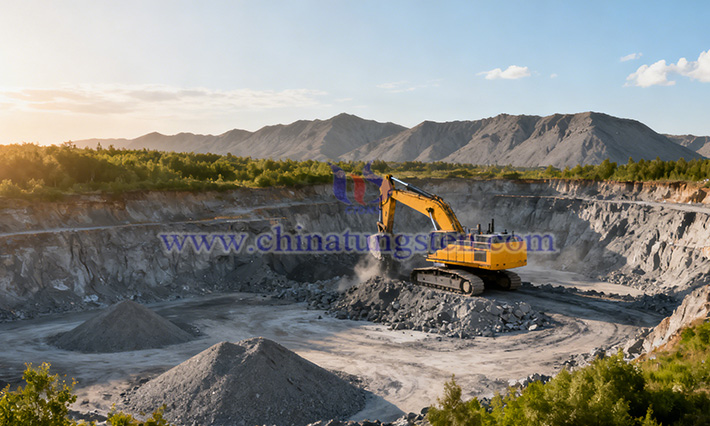
In February, Baiyun Obo forward-lookingly proposed and innovatively deployed a new "2+3+N" industrial system construction pattern. "2+3+N" means "2 flagship industrial chains (mineral resource comprehensive utilization chain, rare earth chain) + 3 key development industry clusters (new materials, modern logistics cluster, enclave economy industrial park) + N key focused industries". Strive to attract and land 10 rare earth industry projects within the year, with rare earth industry output value striving to break through RMB 3 billion.
In February, learned from the China Geological Survey of the Ministry of Natural Resources that China's new round of strategic action for prospecting breakthroughs has achieved remarkable results, with major breakthroughs in strategic emerging industry-related minerals such as rare earth, lithium, zirconium, hafnium, and helium.
On February 19, to implement the "Rare Earth Management Regulations", effectively protect and rationally develop and utilize rare earth resources, maintain ecological security, and promote high-quality development of the rare earth industry, the Raw Materials Industry Department of the Ministry of Industry and Information Technology drafted the "Measures for Total Volume Control of Rare Earth Mining and Rare Earth Smelting Separation (Interim) (Public Consultation Draft)" and "Measures for Rare Earth Product Information Traceability Management (Interim) (Public Consultation Draft)".
In February, China Northern Rare Earth learned from its shareholding company Golden Dragon Rare Earth that its stock will be publicly transferred on the National Equities Exchange and Quotations starting from February 28, 2025.
In March, this year's government work report pointed out that energy resource conservation and ecological environment protection have become hard constraints for the development of the rare earth industry and enterprises, and comprehensively doing environmental protection and low-carbon work is an important lever for enterprises to gain initiative and advantages in fierce competition.
On March 7, Huahong Technology's wholly-owned subsidiary Xintai Technology and its subsidiaries Wanhong Hi-Tech and Jishui Jincheng signed the "Praseodymium-Neodymium Products Procurement 2025 Annual Cooperation Agreement" with China Northern Rare Earth.
In March, Australian research shows that some plants have acquired unique abilities to enrich and utilize rare earth elements during long evolutionary processes.
In March, China Northern Rare Earth plans to invest RMB 73.3645 million to implement the wet smelting and inorganic functional materials pilot base construction project.
In March, a "Rare Earth Magnetic Overrunning Clutch First Set Industrialization Project" of a company in Baotou City achieved large-scale production.

On April 4, the Ministry of Commerce and the General Administration of Customs issued an announcement on implementing export controls on related items of 7 types of medium and heavy rare earths including samarium, gadolinium, terbium, dysprosium, lutetium, scandium, and yttrium, taking effect immediately upon release.
On May 16, Australian Lynas announced that its new production line in Malaysia produced dysprosium oxide for the first time.
In June, Nikkei Asia reported that Japan will propose a package cooperation plan targeting China in tariff negotiations with the U.S., focusing on rare earth and U.S. LNG supply chains interrupted due to U.S.-China tensions, hoping to cooperate with the U.S. on these as priorities.
From June 9 to 10, the first meeting of the China-U.S. Economic and Trade Consultation Mechanism was held in London. It is reported that both sides in principle reached a framework on implementing the consensus from the June 5 phone call between the two heads of state and the Geneva talks. The U.S. Commerce Secretary stated that the trade framework and implementation plan reached between the U.S. and China should resolve restrictions on rare earth and magnets.
On June 14, China National Nuclear Corporation Qinshan Nuclear Power "Hefu No. 1" reported good news again! Yttrium-90 glass microspheres irradiated in heavy water reactor successfully came out of the pile and passed relevant tests, marking China's breakthrough in the situation of high dependence on imports for yttrium-90 microspheres.
On June 18, Australian Lynas announced that its advanced materials factory in Malaysia successfully achieved first mass production of terbium oxide.
On June 19, Yingte released an announcement stating that the company and/or its proposed new wholly-owned or controlling subsidiaries will invest in constructing a high-performance rare earth permanent magnet and component, equipment manufacturing and R&D project in Baotou Rare Earth High-Tech Industrial Development Zone.
On June 20, Xiamen Tungsten agreed to its controlling subsidiary Fujian Golden Dragon Rare Earth establishing a wholly-owned subsidiary Baotou Golden Dragon, with Baotou Golden Dragon constructing a 5,000-ton (first phase) high-performance NdFeB magnetic material project in Inner Mongolia Baotou Rare Earth High-Tech Zone, with expected total investment of RMB 462.22 million.
In June, a Chinese research team achieved a major breakthrough in rare earth chemistry. Researchers from Suzhou University collaborated with researchers from Tsinghua University to successfully prepare rare earth triple bond compounds long considered a "research forbidden zone", breaking traditional understanding of rare earth element bonding capabilities.
In June, multiple automotive and wind power enterprises in the EU, Japan, and the U.S. experienced production reductions or shutdowns due to China's restrictions on rare earth exports.
On June 21, The Times of India showed that India is considering a rare earth production plan worth 35 to 50 billion rupees, aiming to promote domestic rare earth raw material and magnetic material production, with the plan expected to be approved within two weeks.
On July 15, Apple Inc. and U.S. rare earth company MP Materials announced a USD 500 million agreement to procure rare earth magnets and jointly build a rare earth recycling facility in California, marking support from U.S. tech giants for domestic critical mineral supply chains to reduce dependence on Chinese rare earths.
On July 18, the Ministry of State Security published an article "Key Points! It's Not Ordinary Soil", mentioning that rare earth-related items have dual-use civil-military attributes and are national strategic resources. To better safeguard national security and interests, China fully draws on international common practices and lawfully implements export controls on rare earth-related items, without targeting any specific country. However, in recent years, foreign espionage agencies and their agents have attempted to collude with domestic lawbreakers to steal China's rare earth-related items through mailing means, posing serious harm to national security.
In July, the International Mineralogical Association - Commission on New Minerals, Nomenclature and Classification (IMA-CNMNC) unanimously approved the new mineral "Neodymium Huangheite" (Huanghoite-(Nd)) discovered and declared by a joint research team from China University of Geosciences and Inner Mongolia Geological Survey Institute, approval number IMA No. 2025-014.
In July, according to South China Morning Post, in the first half of 2025, Brazil's rare earth exports to China doubled, while China's rare earth imports surged to a historical high.
On July 28, the "Interim Measures for Total Volume Control of Rare Earth Mining and Rare Earth Smelting Separation" were released, taking effect from the date of publication.
On July 31, the General Office of the Sichuan Provincial Government issued the "Opinions on Deeply Promoting the New Round of Strategic Action for Prospecting Breakthroughs and Promoting High-Quality Development of the Mining Industry", mentioning strengthening basic geological surveys of Panxi copper-iron rare earth mines, etc.; vigorously developing advantageous industries such as vanadium-titanium, rare earth, lithium battery, creating internationally influential vanadium-titanium and rare earth industry clusters and domestically leading lithium battery industry development clusters; for Sichuan's advantageous strategic mineral resources such as vanadium-titanium, rare earth, lithium, phosphorus, building a mineral product output statistics system.
In August, according to Inner Mongolia Daily, China's first rare earth disc motor intelligent demonstration line was completed and put into production at the Rare Earth New Materials Technology Innovation Center, with its first mature product—a rare earth permanent magnet axial flux motor with thickness only 6 mm—shocking the industry with breakthrough performance indicators.
On October 9, Ministry of Commerce Announcement No. 61 of 2025 published the decision to implement export controls on related rare earth items to overseas.
On October 9, Ministry of Commerce Announcement No. 62 of 2025 published the decision to implement export controls on rare earth-related technologies.
On October 9, Ministry of Commerce and General Administration of Customs Announcement No. 56 of 2025 published the decision to implement export controls on some rare earth equipment and raw and auxiliary materials related items.
On October 9, Ministry of Commerce and General Administration of Customs Announcement No. 57 of 2025 published the decision to implement export controls on some medium and heavy rare earth related items.
In October, China Northern Rare Earth released an announcement stating that the rare earth concentrate transaction price for the fourth quarter of 2025 is adjusted to RMB 26,205/ton excluding tax (dry quantity, REO=50%), increased by 37.13% month-on-month and increased by 47.37% year-on-year; for each 1% increase or decrease in REO, the price excluding tax increases or decreases by RMB 524.10/ton, increased by 37.13% month-on-month and increased by 47.37% year-on-year.
On October 26, according to Reuters, the U.S. and China reached a "very important framework agreement" in Kuala Lumpur, Malaysia, aimed at easing bilateral trade frictions. The agreement will avoid 100% tariffs on Chinese goods by the U.S. and postpone China's rare earth export control measures.
In October, Tianhe Magnetic Material's wholly-owned subsidiary Tianhe New Materials and Baotou Rare Earth High-Tech Industrial Development Zone Management Committee signed the "Investment Agreement on High-Performance Rare Earth Permanent Magnet and Component, Equipment Manufacturing and R&D Project (Phase I)".
On October 28, the U.S. and Japan signed two important agreements in Tokyo: the first reaffirmed the previous Japan-U.S. tariff agreement framework, with all Japanese exports to the U.S. subject to 15% tariffs, while Japan establishes a U.S. investment fund. The second formulated a framework for U.S.-Japan cooperation in ensuring critical minerals and rare earth supply, including using part of the funds for rare earth mining.
In November, Chinese researchers observed not only large amounts of enriched rare earth elements in a fern plant called Cibotium barometz, but also for the first time observed these rare earth elements "self-assembling" between plant tissue cells, forming a mineral called "lanthanum monazite".
On November 7, the Ministry of Commerce released a message stating that from the date of release until November 10, 2026, Ministry of Commerce and General Administration of Customs Announcements No. 55, 56, 57, 58 of 2025, and Ministry of Commerce Announcements No. 61 and 62 of 2025 are suspended from implementation. The above announcements contain multiple rare earth export control contents.
In November, according to India's Mint report, Pune-based Ashvini Magnets announced that India's first independently built rare earth metal factory has officially started operation. The factory produces 15 tonnes of rare earth metals per month, covering light and heavy rare earth series products, marking India's substantial breakthrough in the rare earth industry chain from ore mining to high-value-added metal processing.
In November, Xiamen Tungsten's controlling subsidiary Golden Dragon Rare Earth plans to issue no more than 26.68 million ordinary shares to its existing shareholders, expected to raise no more than RMB 40.02 million for supplementing working capital.
In November, a breakthrough research achievement completed by Heilongjiang University, Tsinghua University, and National University of Singapore was officially published in Nature, successfully overcoming the world problem of efficient electroluminescence in insulating rare earth nanocrystals.
On November 24, the Ministry of Finance and the State Taxation Administration jointly released the "Announcement on Clarifying the Implementation Caliber of Relevant Resource Tax Policies". The announcement shows that rock-type rare earth concentrate (including bastnaesite concentrate, monazite concentrate, and mixed rare earth concentrate, etc.) produced by taxpayers through washing and other primary processing of mined light rare earth ore shall be subject to resource tax as light rare earth beneficiation products; rare earth material liquid, rare earth carbonate, rare earth oxalate produced by taxpayers from mined ionic rare earth ore through ion exchange principle and other processes, and mixed rare earth oxide produced through burning, oxidation and other processes, shall be subject to resource tax as medium and heavy rare earth beneficiation products.
On November 25, the world's largest rare earth producer outside China, Lynas Rare Earths, released an announcement stating that due to severe power supply interruption, its Kalgoorlie processing plant in Western Australia will experience sharp capacity reduction, expected to have a one-month capacity gap this quarter.
On November 25, Rising Nonferrous released an announcement stating that the company plans to change its Chinese name from "廣晟有色金屬股份有限公司" to "中稀有色金屬股份有限公司", and its stock abbreviation from "廣晟有色" to "中稀有色".
On December 1, the Critical Minerals & Energy Innovation Office of the U.S. Department of Energy released a funding opportunity announcement providing up to USD 134 million to strengthen the domestic rare earth supply chain.
In December, according to the Baotou City Administration for Market Regulation, the international standard "Rare Earths — Determination of Moisture Content in Rare Earth Products — Gravimetric Method" (ISO 24548:2025), led by the Baotou Research Institute of Rare Earths, was officially released, marking another important breakthrough for Baotou City in rare earth international standardization.
On December 12, at the Foreign Ministry regular press conference, a reporter asked: Yesterday, the U.S. signed an agreement with Japan, South Korea, Australia, and other countries to maintain the security of the rare earth supply chain and ensure the development of artificial intelligence technology without dependence on China. What is the Foreign Ministry's comment on this? Foreign Ministry spokesperson Guo Jiakun stated: All parties should abide by market economy and fair competition principles and jointly maintain global industrial and supply chain stability.
On December 29, the State Council Tariff Commission published the "2026 Tariff Adjustment Plan", clearly stating that starting from January 1, 2026, provisional tariff rates will be implemented for rare earth-related imported goods. Among them, rare earth metals such as neodymium, dysprosium, terbium, lanthanum, cerium, praseodymium, yttrium, and scandium, as well as battery-grade and non-battery-grade mixed or fused rare earth metals, scandium, and yttrium, have a most-favored-nation tariff rate of 5% and a provisional tariff rate of 0; at the same time, rare earth compounds such as cerium oxide, cerium hydroxide, lanthanum oxide, yttrium oxide, dysprosium oxide, terbium chloride, terbium fluoride, and neodymium carbonate also have a most-favored-nation tariff rate of 5% and a provisional tariff rate of 0.