The production process of cemented carbide includes three processes of mixture preparation, forming and sintering. In order to make the alloy have higher strength and hardness, producers often dope the bonding metal into the carbide in fine powder form, add other elements if necessary, and then ball mill these materials for a certain period of time to make it becomes a homogeneous and granular mixture with complex requirements. Note: Grinding is usually carried out in organic solvents such as alcohol and ethane.
Cold pressing is a common forming method, which is the process of making the mixture into compacts with a certain density, strength, shape and size. Using molds to make the required product shape, considering that the size of the sintering process will be shortened, the size of the mold should be larger than the size of the final product. Ensuring the uniformity of the density of each part of the compact, no delamination, no cracks, and not well pressed, are the technical points of cold forming.
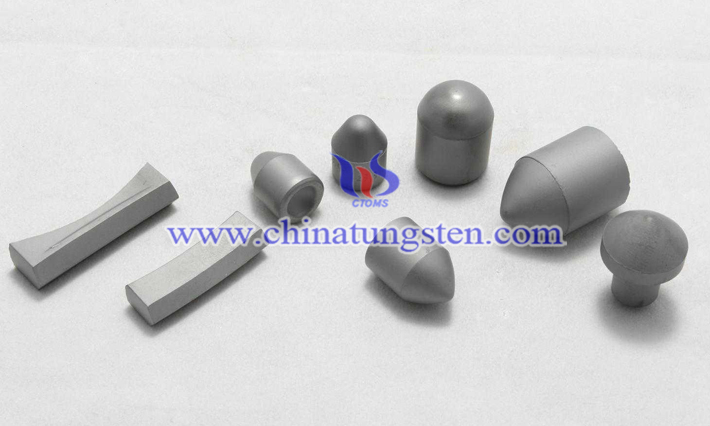 In addition, hot pressing is also a forming method. It is to put the mixture powder into the graphite mold, and limit the forming at the sintering temperature. This method is generally used for large or some special products. The method of producing large and special-shaped products is isostatic restriction. Put the powder into the closed soft mold, and then put it into the liquid in the airtight pressure container, so that the pressure in the liquid is increased, and the powder is properly restricted through the soft mold cover. Since the pressure acting on the powder is the same in all directions, the density of each part of the compact is uniform. Thermoplastic soft resin is now the primary material for manufacturing soft molds. In addition, the kneading forming is suitable for the production of long, uniform cross-section and disorderly shaped products, such as tubes, rods, and tape-like carbides.
The sintering of cemented carbide is liquid phase sintering, that is, when the binder phase is in the liquid phase, the compact is heated in a vacuum furnace to 1350°C to 1600°C, and the linear reduction rate of the compact during sintering is about 18%. The volume is reduced by about 50%, and the exact value of the reduction depends on the particle size of the powder and the composition of the alloy.